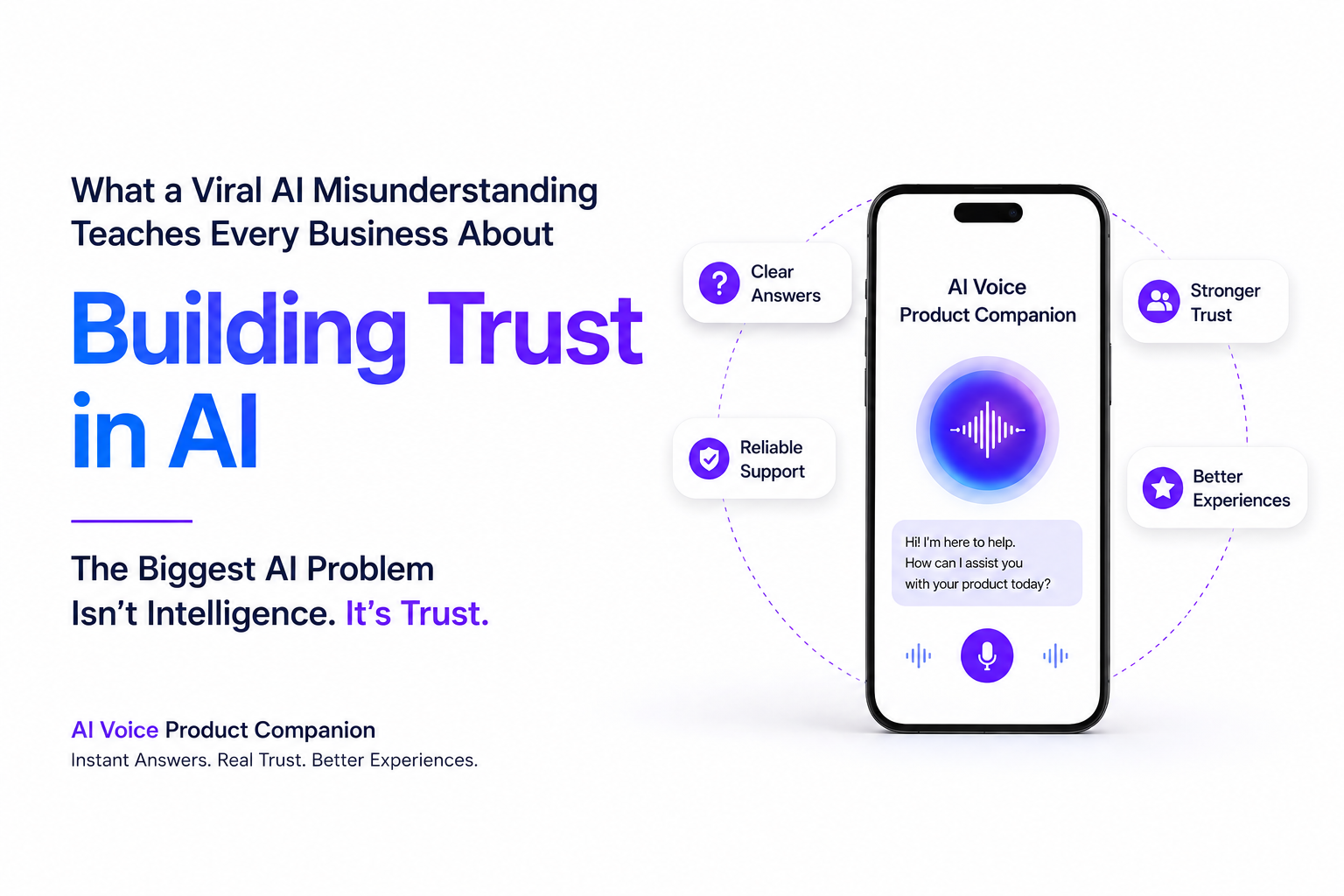
What a Viral AI Misunderstanding Teaches Every Business About Building Trust in AI
What a Viral AI Misunderstanding Teaches Every Business About Building Trust in AI
The biggest AI problem isn't intelligence. It's trust.
Artificial intelligence is changing the way businesses operate. It writes emails, creates content, answers customer questions, and helps organizations work faster than ever before. Every day, a new AI breakthrough promises to make businesses more efficient and customers more satisfied.
But there is one question that every business should be asking:
What happens when customers stop trusting AI?
A recent incident involving an AI-generated image shared by the U.S. Department of Defense (commonly known as the Pentagon) reminded the world that the biggest challenge with AI isn't the technology itself.
It's trust.
And for businesses, trust isn't optional. It's the foundation of every customer relationship.
A Small Image. A Big Reaction.
Recently, the Pentagon shared an AI-generated image that quickly spread across social media.
The image included the phrase:
"Create a WAR."
Within minutes, thousands of people began discussing it online.
Some believed it was announcing a new military initiative.
Others assumed AI was being used to communicate military strategies.
Speculation spread much faster than the facts.
Later, officials clarified that "WAR" was simply an internal acronym and had nothing to do with starting a war or announcing a military program.
But by the time the explanation arrived, the image had already gone viral.
The incident showed just how quickly AI-generated content can be misunderstood when people don't have enough context.
The Real Problem Wasn't the Image
The real problem wasn't the image itself.
The real problem was trust.
Today, AI generates images, videos, voices, articles, and conversations that are becoming increasingly realistic.
As AI becomes more powerful, people naturally become more cautious.
When something seems confusing, people rarely wait for clarification.
Instead, they make assumptions.
And once misinformation begins to spread, rebuilding trust becomes much more difficult.
The lesson is simple:
Even the smartest AI can fail if people don't trust what it says.
Why Every Business Should Pay Attention
Many businesses looked at this incident and thought,
"This is government news. It doesn't affect us."
But the truth is, it affects every business that uses AI.
Imagine a customer buying your product.
They open the box.
Instead of enjoying their new purchase, they're greeted with a thick instruction manual.
They search online but can't find a clear answer.
They contact customer support and spend several minutes waiting.
Finally, they ask an AI chatbot for help.
The chatbot gives an incomplete or confusing response.
At that moment, the customer isn't frustrated with your product.
They're frustrated because they no longer trust the information they're receiving.
And when customers lose trust in the experience, they often lose trust in the brand itself.
AI Doesn't Need to Be Smarter. It Needs to Be Clearer.
Businesses often compete to build the smartest AI.
The fastest AI.
The most advanced AI.
But customers care about something much simpler.
They want answers they can trust.
They don't care how many billions of parameters power your AI model.
They care about questions like:
- How do I set up this product?
- Why isn't it working?
- What should I do next?
- Can someone help me right now?
If AI can't answer these questions clearly and accurately, it stops being helpful and starts becoming another source of frustration.
Customer Support Is Where Trust Is Won—or Lost
Think about the last time you needed help with a product.
Did you enjoy reading a 40-page instruction manual?
Probably not.
Did you enjoy waiting on hold for customer support?
Probably not.
Today's customers don't want to spend time searching through manuals or endless FAQ pages.
They don't want to explain the same issue to multiple support agents.
They simply want the right answer.
Immediately.
And they want to feel confident that the answer is correct.
That is where trust begins.
Introducing Aura — The AI Voice Product Companion
Now imagine a different experience.
You buy a product and simply ask:
"How do I connect this device to Wi-Fi?"
Or,
"Why is this light blinking?"
Or,
"Show me how to use this feature."
Instead of searching through pages of instructions or waiting for support, Aura responds instantly with clear, accurate, voice-guided assistance.
No waiting.
No endless searching.
No confusing documentation.
Just natural conversations.
Aura transforms product support into a simple, intuitive experience.
Unlike generic AI chatbots that rely on broad internet knowledge, Aura is built around your product's information. It understands customer questions in everyday language and delivers reliable, product-specific answers that customers can trust.
More Than an AI Assistant. A Trust Builder.
Many companies see AI as a way to automate customer support.
Aura goes a step further.
It helps businesses build trust.
Every accurate answer increases customer confidence.
Every smooth interaction strengthens your brand.
Every instant solution reduces frustration.
Instead of leaving customers wondering whether they're following the right instructions, Aura provides reliable guidance that helps them move forward with confidence.
That's the difference between an AI chatbot and an AI Product Companion.
One answers questions.
The other builds lasting customer relationships.
The Future of Customer Experience Is Better Conversations
Customer expectations have changed.
People expect answers the moment they need them.
Not tomorrow.
Not after waiting in a queue.
Not after searching through dozens of help articles.
The businesses that succeed in the AI era won't necessarily have the largest support teams.
They'll have the best customer experiences.
Experiences where customers feel understood, supported, and confident from the very first interaction.
One AI Incident. One Powerful Lesson.
The Pentagon incident wasn't really about a single image.
It was about what happens when people don't fully understand AI.
Without clarity, people make assumptions.
Without trust, even accurate information gets questioned.
For businesses, this is one of the biggest lessons of the AI era.
As AI becomes part of every customer journey, success won't be measured only by how advanced your technology is.
It will be measured by how much your customers trust it.
Trust Is the New Competitive Advantage
Every product tells a story.
Every customer interaction either strengthens that story or weakens it.
The brands that lead the future won't simply use AI to answer questions.
They'll use AI to eliminate confusion, build confidence, and create trust at every stage of the customer journey.
That's exactly why Aura — The AI Voice Product Companion exists.
Not to replace human support.
Not to overwhelm customers with technology.
But to make every product easier to understand, every interaction more helpful, and every customer more confident.
Because in the age of AI, the most valuable innovation isn't artificial intelligence.
It's trust.
Continue reading: What Is an AI Product Companion? A Complete Guide for Modern Brands
Ready to bring an AI product companion to your own devices? See pricing or talk to our team.