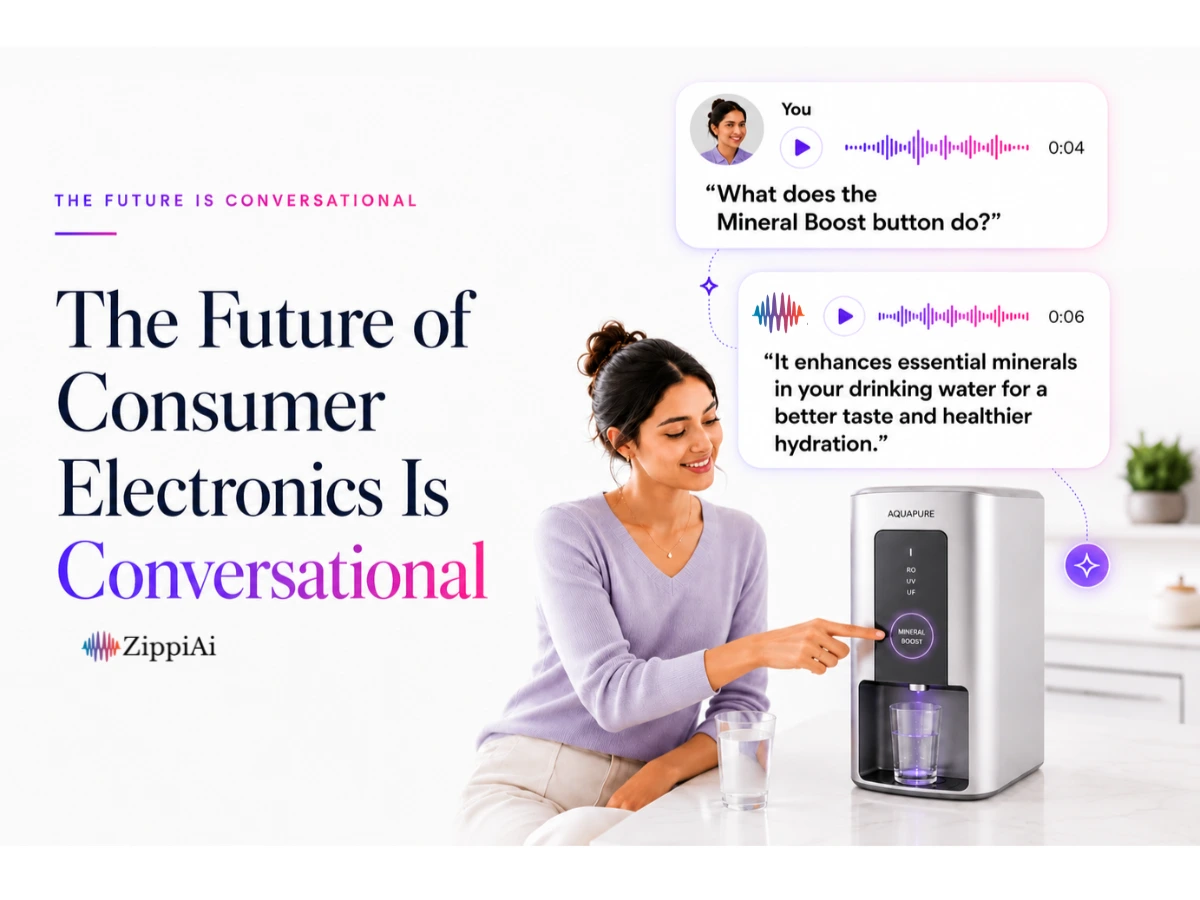
The Future of Consumer Electronics Is Conversational
A friend recently bought a high-end air purifier. It cost more than her first laptop. It arrived in beautiful packaging, with a companion app, seven sensors, and a promise printed on the box: “Intelligent air, automatically.” Two weeks later she texted me a photo of the unit blinking an amber light she didn’t understand, next to a 60-page manual she hadn’t read, asking if I knew what it meant.
I didn’t. Neither did she. And here is the quietly damning part: neither did the device. It had the sensors to know exactly what was wrong. It simply had no way to tell her. All that intelligence, trapped behind a blinking light and a PDF.
That gap between what a product knows and what it can say is the most important unsolved problem in consumer electronics today. And it is about to be solved. The result will reshape how brands compete, how customers choose, and what “good hardware” even means.
Four Eras, One Direction
To see where this is going, it helps to see how far we’ve already come. Consumer electronics have moved through four distinct eras, and each one quietly raised the bar for what a product is expected to do on its own.
The first was the era of basic devices a toaster, a radio, a fan. They did one thing, they did it on command, and the entire relationship was contained in an on/off switch. Then came connected devices: the same machines, now with a Wi-Fi chip and an app. You could turn your lights on from your phone, which felt like magic for roughly a week before it felt like one more icon to manage.
The third era the one most brands still believe they live in was the age of smart devices. These products didn’t just connect; they sensed, automated, and adapted. A thermostat that learns your schedule. A watch that counts your steps. A TV that knows what you watched last night. Intelligence moved into the product itself.
But a fourth era is now arriving, and it changes the relationship entirely. Call them conversational devices. These are products that don’t just sense and react they understand intent, explain themselves, guide you through their own complexity, and reach out before you have to. The shift sounds incremental. It is not. It is the difference between a tool that waits to be operated and a partner that participates.
Customers no longer want a device that is merely capable. They want one that is comprehensible.
The expectation has already changed, even if the products haven’t caught up. People now assume that anything with a screen or a chip should respond intelligently, understand what they’re trying to do, walk them through it, and offer help before they get stuck. That assumption was set by the phones in their pockets and the assistants in their kitchens. Every other device in the home is now judged against it and most are failing the comparison.
Why “Smart” Is No Longer Enough
Here is the uncomfortable truth about smart devices: most of them are smart for the company, not for the customer. They generate data, enable features, and look impressive in a keynote. But the moment of actual use the unboxing, the setup, the confusing error, the feature nobody discovers is often as clumsy as it was a decade ago.
Think about the friction that still defines product ownership. Onboarding that assumes you’ll happily pair three apps and create two accounts. Manuals written by engineers for engineers, then translated badly. Genuinely useful features buried four menus deep, used by almost no one. And when something goes wrong, a support journey that begins with a chatbot that can’t help and ends with a 25-minute hold.
The deeper problem is a mismatch of mental models. A smart device behaves like a machine: it exposes controls and waits for correct input. But customers don’t want to operate a machine. They want to express a goal “make this room comfortable,” “help me sleep better,” “why is this light blinking” and have the product handle the translation. They want an assistant, not an instrument panel.
This is why feature count has stopped being a reliable advantage. A product with forty features that nobody can find is, in practice, a product with the three features people stumbled onto. Capability that can’t be communicated is capability that doesn’t exist not in the customer’s experience, and not on the balance sheet of loyalty and lifetime value.
The Rise of Conversational Consumer Electronics
Walk through the categories changing right now and a pattern emerges. The intelligence isn’t new — the ability to express it is.
A smart television used to bury its picture settings in a thicket of sliders. The conversational version notices you’re watching a film in a dark room and offers, in plain language, to switch to a cinema profile explaining what it changed and why. An air conditioner no longer waits for you to fiddle with a remote; it learns the rhythm of the room, quietly optimizes for comfort and cost, and tells you what it did when you ask.
A wearable stops dumping a wall of charts on you. Instead it says, in human terms, that your resting heart rate has crept up over three nights and gently asks whether you’ve been sleeping less turning raw biometrics into something a person can actually act on. And the appliance that throws an error no longer abandons you to a manual. It explains what happened, asks one clarifying question, and walks you to a fix or books the service call itself.
Underneath all of these is the same movement: from menus to dialogue, from buttons to intent, from one rigid input method to voice-first and multimodal interaction that meets people where they are. The device is no longer something you operate. It is something you talk to and, increasingly, something that talks back at the right moment, unprompted and useful.
The most advanced products of the next decade won’t feel like tools at all. They’ll feel like companions that happen to be made of glass and aluminum.
That word companion matters. A tool is something you pick up when you need it and forget when you don’t. A companion is present, aware, and engaged over time. When a product crosses that line, the customer’s relationship with the brand stops being a transaction and becomes a continuity. That is the prize.
From Product Experience to Relationship Experience
For most of the industry’s history, the customer relationship effectively ended at checkout. The brand’s job was to win the comparison better specs, sharper screen, lower price and the moment the box was sold, attention shifted to the next quarter’s model. Everything after purchase was cost: support tickets, returns, warranty claims.
Conversational products quietly invert that logic. When a device can talk, the most valuable part of the relationship begins after the sale, not before it. Onboarding becomes a guided conversation instead of a leap of faith. The dozens of features become discoverable because the product can introduce them at the right moment. Support becomes a dialogue the customer actually finishes. Each of these interactions is a chance to deepen the relationship rather than strain it.
This reframes what brands are really competing on. The spec sheet still matters, but it is increasingly table stakes. The differentiators that move retention and referrals now live elsewhere: usability, personalization, ongoing engagement, and the brand’s actual intelligence about how its products are used. Two companies can ship near-identical hardware; the one that maintains a living conversation with its customers will win the second purchase, the upsell, and the word-of-mouth.
It is the streaming-versus-disc lesson all over again. The disc was a product you bought once. The stream is a relationship you stay inside. Conversational electronics turn one-time hardware into something closer to an ongoing relationship and relationships, not transactions, are what compound.
Why AI Companions Will Become Core Infrastructure
If the relationship is the asset, then the thing that maintains it becomes infrastructure as fundamental as the supply chain or the app. That “thing” is what I’d call an AI companion: a layer that sits with the product and the customer, fluent in the brand’s entire knowledge, available the instant a question arises.
Picture what a well-built companion does across the lifecycle. It answers customer questions immediately, at two in the morning, without a queue. It turns setup from a chore into a guided walk-through. It educates owners about the features they paid for but never found. It deflects the routine support volume that clogs call centers, freeing human agents for the cases that truly need them. And quietly, in the background, it does something even more valuable.
It listens at scale. Every conversation is a signal: where people get confused, which features delight, what frustrates them into silence, and crucially the early tremors of churn. A companion can notice that a customer has stopped engaging, that their questions have turned frustrated, that adoption has stalled, and it can act on those signals before the customer quietly decides never to buy from you again. Support becomes a sensor. Conversation becomes telemetry.
This is where platforms like ZippiAi enter the picture not as a gadget, but as the connective tissue between a brand’s products and its customers. An AI companion platform lets a manufacturer give every device a voice without building a conversational AI team from scratch: ingesting the product knowledge, handling onboarding and support as natural dialogue, and turning the resulting interactions into insight the product and CX teams can act on. The point isn’t the chatbot. The point is that the relationship finally has somewhere to live.
Brands that treat this as a feature will bolt a chat window onto an app and call it done. Brands that treat it as infrastructure will design the entire post-purchase experience around continuous, intelligent conversation and the gap between those two approaches will become one of the defining competitive lines of the decade.
Where Conversation Meets the Edge
There is a technical reason this future is arriving now rather than five years ago, and it lives in an unglamorous phrase: edge AI. For a conversational product to feel like a companion, it has to respond at the speed of thought. A two-second pause while a request travels to a distant server and back is the difference between a dialogue and a delay and customers feel that difference instantly, even if they can’t name it.
Moving intelligence closer to the user onto the device or the local network collapses that latency. Responses become immediate. Interactions feel natural rather than transactional. And it solves a second problem that grows more urgent every year: privacy. A conversation about your sleep, your home, your health, or your habits is intimate. When the intelligence to handle it lives near you rather than streaming everything to the cloud, the customer keeps more control and the brand earns more trust.
The most compelling conversational experiences will be hybrids: fast, private, on-device understanding for the everyday, paired with deeper cloud intelligence for the complex. As that balance shifts toward the edge, conversational interfaces stop feeling like a service you summon and start feeling like a presence that’s simply there. Proximity, it turns out, is a feature.
The Quiet Goldmine: Behavioral Intelligence
Every conversation a product has is also data — but not the cold, anonymized telemetry brands are used to. Conversational data is intent made legible. When a customer asks a question, complains, gets stuck, or expresses delight, they are telling you, in their own words, exactly what they think of your product. No survey has ever been this honest.
In aggregate, these interactions surface things dashboards never could: the precise sentence where onboarding loses people, the feature that generates ten times more questions than any other, the recurring frustration that no one ever filed a formal complaint about, the patterns that predict who will stay engaged and who will drift away. This is the difference between knowing that a feature is rarely used and knowing why because customers keep asking for it by a different name.
Fed back into the organization, this intelligence becomes a flywheel. Product teams learn what to fix and what to build. Marketing learns the language customers actually use. CX learns where to intervene. The next generation of hardware ships already shaped by what a million conversations revealed about the last one. The conversation doesn’t just serve the customer it teaches the company.
The Human Side of an Intelligent Machine
It would be easy to read all of this as a story about technology. It isn’t. The deepest reason conversational products will win has nothing to do with chips or models and everything to do with how people feel when they use them.
Modern life is saturated with complexity. Every device demands a little attention, a little learning, a little troubleshooting, and the cumulative weight of that cognitive load is exhausting. What people crave from their products is not more power. It is relief: guidance when they’re unsure, reassurance when something seems wrong, personalization that respects who they are, simplicity that removes decisions, and the quiet emotional ease of a thing that just works and can explain itself when it doesn’t.
The most valuable thing a product can give a person today is not another feature. It’s the feeling of being understood.
A conversational product delivers that feeling structurally. It absorbs complexity so the customer doesn’t have to. It turns the anxious moment of a blinking amber light into a calm sentence: “The filter needs replacing here’s the exact one, and I can order it for you.” My friend with the air purifier didn’t want a smarter machine. She wanted to stop feeling stupid in her own living room. That is the emotional bar, and it is the one most brands are still failing to clear.
The Competitive Future: Conversation as a Category
Step back far enough and the trajectory is unmistakable. In the next five years, conversational intelligence will become as decisive a competitive factor as build quality and performance and in some categories, more so. We have seen this pattern before, and it always looks the same in hindsight: obvious, inevitable, and brutal to the companies that dismissed it as a gimmick.
Smartphones didn’t beat feature phones on call quality; they beat them on interaction. Streaming didn’t beat cable on content alone; it beat it on experience and relationship. Touchscreens didn’t beat buttons because they were cheaper; they beat them because they felt natural. In each case, the incumbents had better specs on the dimension they were measuring and lost anyway, because the basis of competition had shifted underneath them. Conversation is that shift, arriving now.
The brands that recognize this early will treat conversational ability not as a marketing line but as a core design constraint, the way battery life and durability are today. They’ll ask, of every product decision: can the customer understand this, ask about this, be guided through this? The brands that don’t will keep winning spec comparisons in a market that has quietly stopped caring about them.
What Winning Actually Looks Like
The future of consumer electronics will not be decided by who builds the smartest device. We are already drowning in smart devices. It will be decided by who builds devices that understand, guide, and communicate naturally with the people who own them products that turn the lonely moment of confusion into a conversation, and the one-time sale into a lasting relationship.
The hardware will keep getting better; that is a given, and a race nearly everyone can run. The durable advantage now lies in the layer above the hardware: the intelligence that listens, explains, anticipates, and stays. That is where loyalty is built, where churn is caught, where the next product is quietly designed, and where the brands of the next decade will separate from the rest.
The blinking amber light is still on, in millions of homes, on millions of devices that know exactly what’s wrong and have no way to say it. The companies that win the future won’t simply build smarter machines. They’ll build machines that can finally speak and customers, at last, who feel heard.
If this resonated, it’s worth sharing with the product, CX, and innovation leaders thinking about what comes after “smart.” The shift from devices to conversations is the kind of change that looks optional right up until it isn’t.