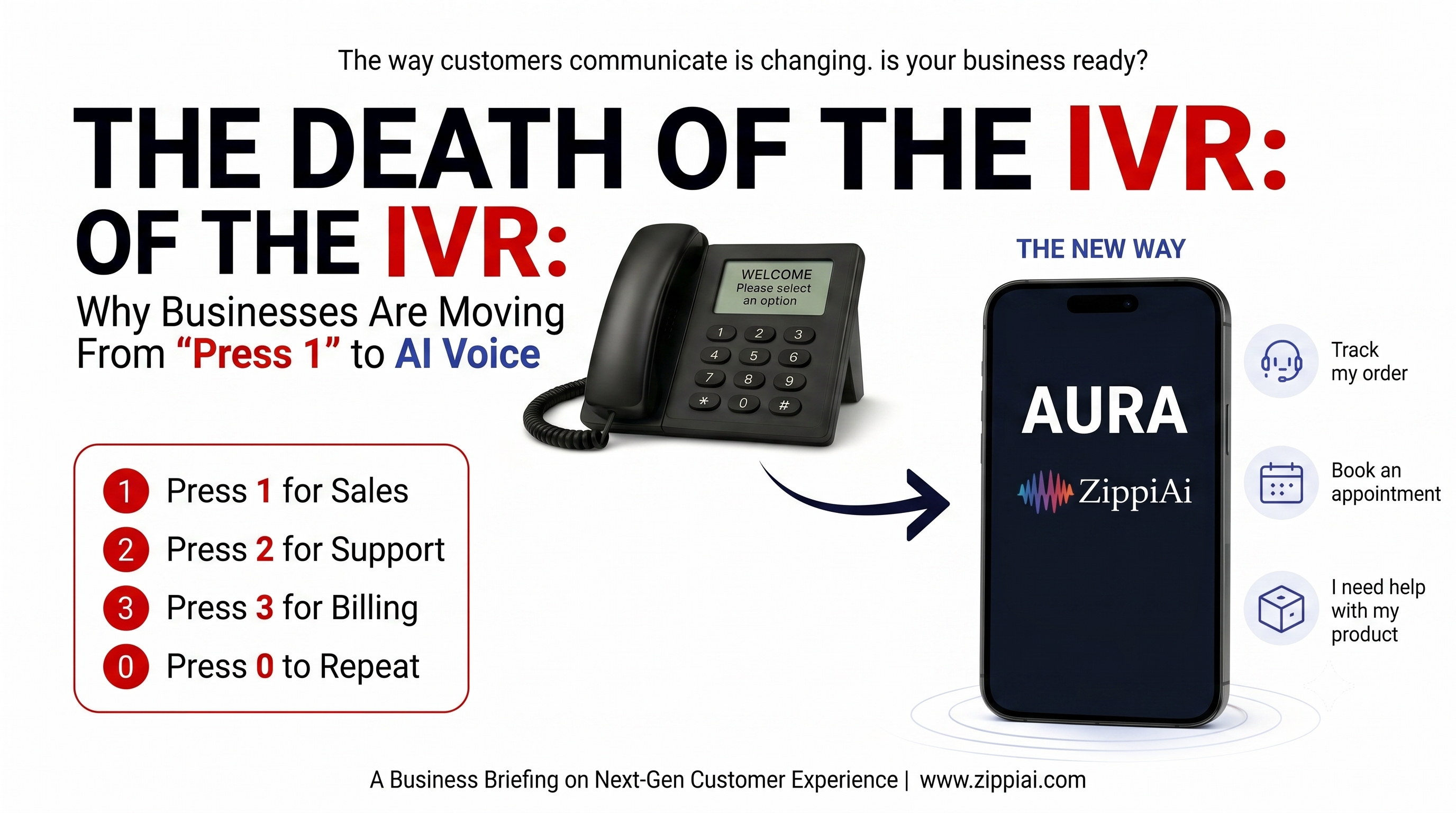
The Death of the IVR: Why Businesses Are Moving From "Press1" to AI Voice.
The Death of the IVR: Why Businesses Are Moving From “Press 1” to AI Voice.
For decades, customer service has started with the same familiar instruction:
“Press 1 for Sales. Press 2 for Support. Press 3 to repeat this menu.”
Interactive Voice Response (IVR) systems transformed customer service by helping businesses handle large call volumes without requiring a human agent for every interaction.
But customer expectations have changed.
Today, customers don't want to navigate a maze of menus just to explain what they need. They want to speak naturally, ask questions, get relevant answers, and solve their problems quickly.
This is why businesses are increasingly exploring AI voice and conversational AI as the next evolution of customer communication.
The traditional IVR may not disappear overnight, but the “press 1, press 2” experience is becoming increasingly outdated.
What Is an IVR?
Interactive Voice Response (IVR) is an automated telephone system that interacts with customers through pre-recorded messages, keypad inputs, or basic voice commands.
A typical IVR experience sounds like:
“Press 1 for billing.”
“Press 2 for technical support.”
“Press 3 for sales.”
IVR systems work well when customer requests are predictable and can be organized into predefined categories.
The problem begins when a customer has a question that doesn't fit neatly into those categories.
Instead of simply explaining their problem, the customer has to find the correct menu, select an option, wait for a transfer, and sometimes repeat the same information to another agent.
That creates friction.
Why Are Traditional IVRs Becoming Outdated?
The biggest limitation of traditional IVR systems is that they are designed around menus rather than conversations.
Customers think in terms of problems:
“My order hasn't arrived. Can you check where it is?”
An IVR thinks in terms of options:
“Press 1 for orders. Press 2 for delivery. Press 3 for something else.”
This difference matters.
Traditional IVRs can struggle with complex or unexpected questions, natural conversational language, understanding context across multiple questions, personalized interactions, multilingual conversations, and requests that require multiple steps.
As customer expectations continue to evolve, businesses need voice systems that can understand what customers actually mean rather than simply directing them through predefined menus.
What Is AI Voice?
AI voice uses technologies such as speech recognition, artificial intelligence, natural language processing, and text-to-speech to allow people to communicate with software through natural conversation.
Instead of saying:
“Press 1 for order support.”
A customer can simply say:
“Hi, I placed an order yesterday, but I haven't received a confirmation. Can you check it for me?”
The AI can understand the customer's intent and respond accordingly.
The important difference isn't simply that AI can “talk.”
The real change is that the interaction becomes conversational.
Customers can explain what they need in their own words instead of learning how to navigate a company's phone system.
AI Voice vs. Traditional IVR: What's the Difference?
The biggest difference between traditional IVR and AI voice is how they understand and respond to customers. A traditional IVR is menu-driven, meaning customers have to follow predefined options such as “Press 1 for Sales” or “Press 2 for Support.” It works well for simple and predictable requests, but becomes frustrating when a customer's question doesn't fit into the available options. AI voice, on the other hand, is conversation-driven. Instead of asking customers to navigate menus, it allows them to explain what they need using natural language. AI voice can understand the customer's intent, maintain context throughout a conversation, and provide more relevant responses. While traditional IVR follows fixed paths, AI voice can adapt to different questions and situations, creating a more natural and personalized customer experience. The fundamental difference is simple: an IVR asks, “Which option do you want?” while AI voice asks, “What do you need help with?” This shift from menu-based navigation to natural conversation is what makes AI voice a powerful alternative to traditional IVR systems.
Why Are Businesses Moving Toward AI Voice?
1. Better Customer Experience
Customers can speak naturally instead of navigating complicated menus.
They don't necessarily need to know which department handles their issue. They can simply explain what they need and allow the AI to determine the appropriate next step.
This can make customer interactions feel faster, simpler, and more intuitive.
2. Faster Resolution
Traditional IVRs can require customers to move through several menu levels before reaching the right department.
AI voice can identify the customer's intent from the conversation and guide the interaction more directly.
For simple and repetitive requests, this can reduce unnecessary transfers and repeated explanations.
3. 24/7 Customer Support
AI voice systems can operate around the clock.
For businesses serving customers across different time zones, this means customers can receive assistance even outside traditional business hours.
Instead of making customers wait until the next working day, businesses can provide immediate assistance for many routine interactions.
4. Multilingual Customer Communication
Language can become a major challenge when businesses expand into new markets.
AI voice can support multilingual conversations, helping businesses communicate with customers in the language they are most comfortable using.
This creates an opportunity for companies to use voice AI not only for customer support but also as part of their global expansion strategy.
5. From Answering Questions to Taking Action
The biggest evolution in voice AI isn't simply replacing an old IVR voice with a more natural-sounding voice.
It is the transition from AI that answers questions to AI that helps complete tasks.
Modern AI voice systems can potentially connect with business tools, knowledge bases, CRM platforms, booking systems, and other workflows.
This changes the interaction from:
Question → Answer
to:
Question → Understanding → Action → Outcome
That is where voice AI becomes much more valuable to businesses.
Is AI Voice Going to Replace Human Customer Service?
Not completely.
AI voice is not about replacing every human customer-service interaction.
Complex, sensitive, or high-value situations may still require human expertise, empathy, and judgment.
Instead, the future of customer service is likely to combine AI and human agents.
AI can handle routine questions, repetitive tasks, basic product guidance, and initial customer interactions, while human employees can focus on more complex situations.
The goal isn't to remove humans from customer service.
The goal is to remove unnecessary friction from the customer journey.
What Does the Future of Customer Communication Look Like?
The future isn't about forcing customers to understand a company's internal structure.
Customers shouldn't have to know whether their issue belongs to sales, billing, technical support, or another department.
They should simply be able to explain what they need.
This represents a fundamental shift:
From menus to conversations.
From navigation to understanding.
From answering questions to completing tasks.
Traditional IVRs played an important role in the development of automated customer service. But as AI voice becomes more capable, businesses have an opportunity to create interactions that feel less like navigating a phone system and more like having a conversation.
Where Does Aura Fit In?
This is the shift Zippy AI is building toward with Aura, an AI voice product companion.
Aura is designed around a simple idea: customers shouldn't always have to search through manuals, complicated instructions, or static product information to understand how a product works.
Instead, they can interact with the product through natural voice conversations and receive guidance when they need it.
For businesses, this creates an opportunity to make products easier to understand, improve customer interactions, and turn product-related questions into meaningful conversations.
The future of customer communication isn't about making customers better at navigating technology.
It's about making technology better at understanding customers.
And that is why the next generation of customer communication won't begin with:
“Press 1.”
It will begin with:
“How can I help?”
Continue reading: What Is an AI Product Companion? A Complete Guide for Modern Brands
Ready to bring an AI product companion to your own devices? See pricing or talk to our team.
Related reading: For how this plays out specifically in consumer electronics, read Why Voice AI Companions Are Replacing IVRs in Consumer Electronics.