AI Agent Evaluation: Why 42% Still Fail After Testing
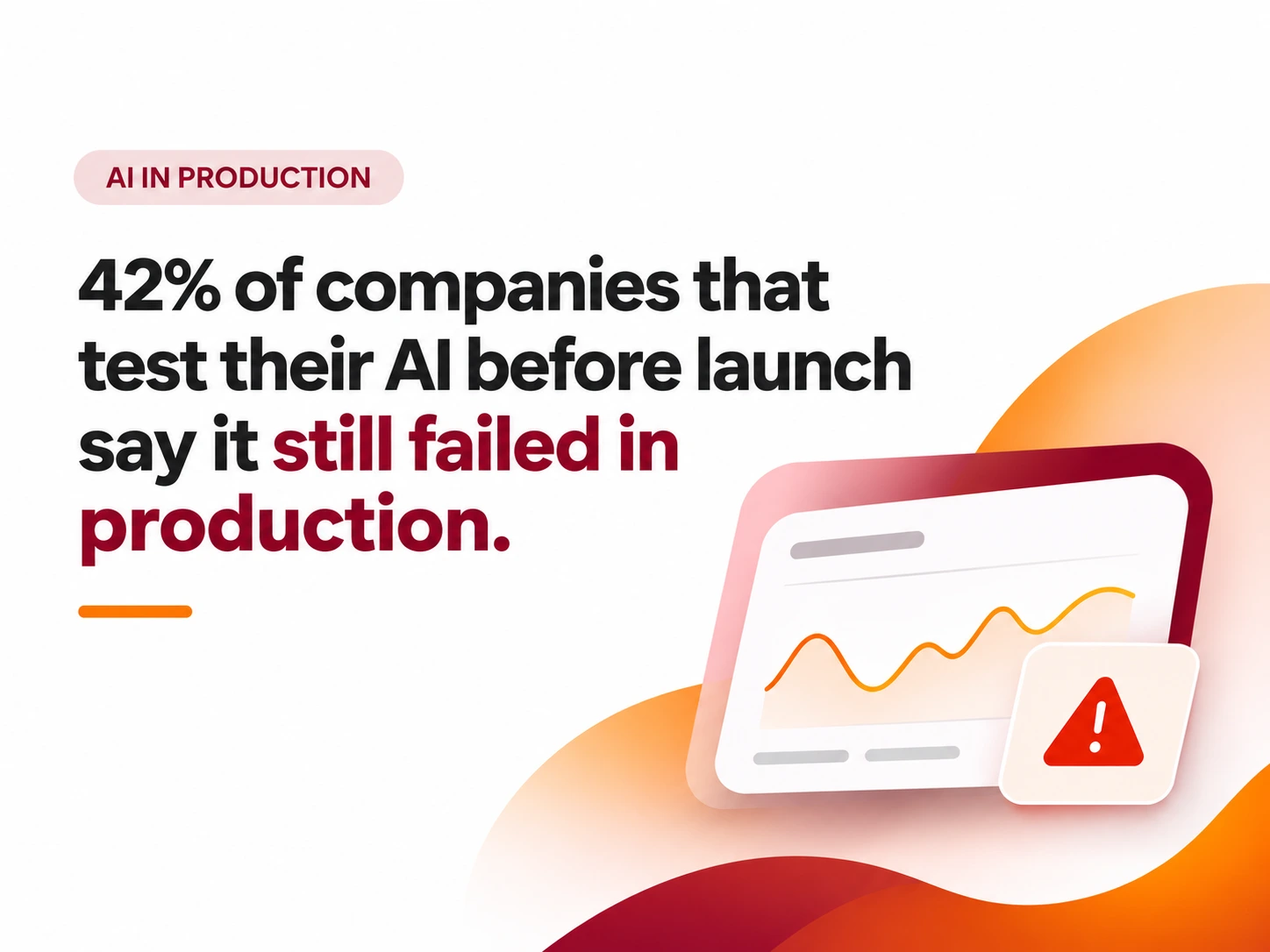
42% of Companies Saw an AI That Passed Its Tests Fail Anyway
A new VentureBeat survey finds that pre-launch testing doesn't stop AI failures reaching customers, and that four in ten companies have no automated way to notice when an AI gives a bad answer. The same week, PayPal showed what fixed its accuracy problem. It wasn't a better model.
AI agent evaluation before launch is now standard practice. In VentureBeat Intelligence's October 2026 Agentic Reliability and Evals survey, 102 of the 106 qualified respondents said their organisations run pre-deployment evaluations. The question is what those tests catch.
The answer, published on 10 November, isn't reassuring:
- 42% of respondents whose organisations run pre-deployment evaluations said an agent or LLM feature "had passed internal tests but subsequently failed within the preceding year".
- 49% of those reporting failures said their most significant incident reached customers. That is about one in five of all the organisations that test.
- 39% of all respondents said they have no automated checks or monitoring alerts. They would only find out about incorrect or low-quality AI output when a person noticed it.
The sample is small and self-selected: VentureBeat surveyed 117 people and 106 qualified, all working on AI at organisations with 100 or more employees, or consulting for them. Each figure has a different base, as shown in the table below. Even so, the pattern matches every earlier wave of the same tracker. In June, 50% of 157 respondents said an AI feature that passed internal evaluations had gone on to cause a customer-facing failure. In July it was 49% of 108. The question wording has changed since, so the waves shouldn't be read as a trend line. The finding has stayed the same.
AI agent testing is a gate, not production monitoring
Pre-launch evaluations answer one question: is this agent good enough to go live? They can't answer whether it is still good enough on the hundredth day, after a model update, a new product line, a policy change or a spike in calls about something nobody tested for.
That's the job of production monitoring, and it is where the gap shows. Put the VentureBeat numbers next to what contact centres report about their own quality checks:
Finding | Figure | Base | Source |
|---|---|---|---|
AI passed internal tests, then failed within a year | 42% | Orgs that run pre-deployment evals (102) | VentureBeat Intelligence, Oct 2026 |
Most significant failure reached customers | 49% | Those reporting a failure (43) | VentureBeat Intelligence, Oct 2026 |
No automated checks or alerts; rely on people to notice | 39% | All qualified respondents (106) | VentureBeat Intelligence, Oct 2026 |
Every AI-generated evaluation is reviewed | 14% | 600 UK and US contact-centre professionals | ScorebuddyCX QA & CX Pulse, 2026 |
Still sample calls manually | 49.5% | 300 UK contact-centre managers and directors | MaxContact Conduct Risk Report, 2026 |
The rows tell one story from two directions. AI teams say tests let failures through and that a large share have no alarm in production. Contact centres say that half of them still check a sample of conversations by hand, and that few check the AI's own scoring every time. In that setup, the customer is often the monitor: a bad answer shows up first as a complaint, a repeat call or a cancelled order.
Improving AI agent accuracy: PayPal's fix wasn't the model
The same VentureBeat article carries a useful counter-example. PayPal built an internal assistant that answers business questions that would normally go to its data science team. Ren Zhang, PayPal's VP and global head of AI product, said the assistant's question-answer accuracy went from 43% to 95% without a change to the underlying model.
What changed was a knowledge layer, kept separate from the model. It holds "golden queries", which set out how to retrieve the data for a given purpose, and "analytical playbooks", which set out how to investigate a type of question. Zhang reported more than 1,000 questions and an estimated 1,600 hours saved over 10 weeks.
Two caveats matter. This is an internal tool, not a customer-facing one, and VentureBeat doesn't say how the 43% or the 95% were measured. But the result echoes another one from September. Salesforce AI Research took a frozen GPT-5.5 agent from finishing 43.5% of browser tasks to 93% by evolving only the harness around it, not the model.
The lesson for support teams is the same in both cases. Most of the accuracy that matters lives in the layer around the model: the approved knowledge, the procedures, the checks. A contact-centre study found that limiting a bot to approved, verified answers cut unsupported content to near zero. And that layer changes every week in a contact centre, as prices, policies and products change. A test passed at launch says nothing about the knowledge base six weeks later.
Five AI agent monitoring practices for contact centres
- Treat launch tests as the minimum. They prove an agent can work. They don't prove it still works. Every model swap, prompt change and knowledge update should be re-tested against a fixed set of your hardest real conversations. Which outcomes to score is covered in our guide to the metrics every CX leader should track in an AI-first support model.
- Get out of the 39%. If nothing in your stack would raise an alert when the AI starts giving wrong answers, the first alert will be a customer. Live checks on output correctness, not just on uptime, are the minimum.
- Score every conversation, not a sample. Manual sampling of a few per cent of calls was built for human agents. An AI agent can repeat the same mistake thousands of times between samples.
- Score outcomes, not tone. A call can sound fine and still fail: a refund promised but not issued, an address that never saved. Check what the agent did in the back-end systems, not only what it said. The same outcome data is what tells you whether a cheaper model really lowers your cost per resolved call.
- Version the knowledge, not just the model. If PayPal's gain came from its knowledge layer, a regression can come from there too. Record which knowledge version was live for each conversation so a failure can be traced to a change.
Frequently asked questions
What is AI agent evaluation?
AI agent evaluation is the testing of an agent's answers and actions against expected outcomes. Pre-deployment evaluation decides whether an agent is good enough to launch; production monitoring checks every live conversation after launch. The two do different jobs.
How often do AI agents that pass evaluation fail in production?
In VentureBeat Intelligence's October 2026 survey, 42% of respondents whose organisations run pre-deployment evaluations said an AI feature had passed internal tests but failed within the following year. 49% of those said their most significant incident reached customers. The sample is small (106 qualified) and self-selected.
How should contact centres monitor AI agents?
Score every conversation rather than a sample, alert on answer correctness rather than just uptime, check what the agent did in back-end systems as well as what it said, and re-test against your hardest real conversations after every model, prompt or knowledge change.
Where Aura stands
We build a voice AI companion and the analytics behind it for enterprise support. Our view is that pre-launch testing and live monitoring are two different jobs, and the second one is the one most teams are missing. Aura scores every call against its outcome and records what was live when it happened, so a failing answer shows up on a dashboard before it shows up as a complaint.